 Add to Chrome
 Add to Firefox
 Add to Edge
HorizonStream: Long-Horizon Attention for Streaming 3D Reconstruction
May 22, 2026
Online 3D reconstruction requires estimating camera pose and scene geometry under strict causal and bounded-memory constraints. Existing methods often suffer from drift, jitter, or collapse on long sequences. We trace these failures to a fundamental mismatch. Streaming geometry is inherently temporally heterogeneous, with evidence ranging from short-lived correspondences to persistent global scale. However, current architectures impose uniform and pathological influence patterns. For example, sliding windows enforce hard cutoffs, while ungated recurrence and causal attention cause cache saturation and spike-like attention sinks. To resolve this, we formalize geometric propagation as an \emph{evidence influence kernel} and propose HorizonStream, a long-horizon Transformer that explicitly factorizes this kernel. For the long-range temporal factor, Geometric Linear Attention learns channel-wise decay rates to enable bounded, multi-timescale propagation of geometric evidence. For the short-range spatial factor, Geometric Local Attention with Spatiotemporal RoPE performs reliable 3D matching while suppressing attention sinks. Finally, Metric Readout Tokens recover stable scale and rigid pose directly from the persistent geometric state. Extensive experiments show that HorizonStream, trained on only 48-frame clips, generalizes stably to sequences exceeding 10,000\ frames with constant memory and linear time, achieving state-of-the-art streaming 3D reconstruction performance. Project Page: https://3dagentworld.github.io/horizonstream/

MotionGRPO: Overcoming Low Intra-Group Diversity in GRPO-Based Egocentric Motion Recovery
May 07, 2026This paper studies full-body 3D human motion recovery from head-mounted device signals. Existing diffusion-based methods often rely on global distribution matching, leading to local joint reconstruction errors. We propose MotionGRPO, a novel framework leveraging reinforcement learning post-training to inject fine-grained guidance into the diffusion process. Technically, we model diffusion sampling as a Markov decision process optimized via Group Relative Policy Optimization (GRPO). To this end, we introduce a hybrid reward mechanism that combines a learned conditioned perceptual model for global visual plausibility and explicit constraints for local joint precision. Our key technical insight is that policy optimization in diffusion-based recovery suffers from vanishing gradients due to limited intra-group sample diversity. To address this, we further introduce a noise-injection strategy that explicitly increases sample variance and stabilizes learning. Extensive experiments demonstrate that MotionGRPO achieves state-of-the-art performance with superior visual fidelity
MultiGO++: Monocular 3D Clothed Human Reconstruction via Geometry-Texture Collaboration
Mar 05, 2026Monocular 3D clothed human reconstruction aims to generate a complete and realistic textured 3D avatar from a single image. Existing methods are commonly trained under multi-view supervision with annotated geometric priors, and during inference, these priors are estimated by the pre-trained network from the monocular input. These methods are constrained by three key limitations: texturally by unavailability of training data, geometrically by inaccurate external priors, and systematically by biased single-modality supervision, all leading to suboptimal reconstruction. To address these issues, we propose a novel reconstruction framework, named MultiGO++, which achieves effective systematic geometry-texture collaboration. It consists of three core parts: (1) A multi-source texture synthesis strategy that constructs 15,000+ 3D textured human scans to improve the performance on texture quality estimation in challenge scenarios; (2) A region-aware shape extraction module that extracts and interacts features of each body region to obtain geometry information and a Fourier geometry encoder that mitigates the modality gap to achieve effective geometry learning; (3) A dual reconstruction U-Net that leverages geometry-texture collaborative features to refine and generate high-fidelity textured 3D human meshes. Extensive experiments on two benchmarks and many in-the-wild cases show the superiority of our method over state-of-the-art approaches.
SAT: Supervisor Regularization and Animation Augmentation for Two-process Monocular Texture 3D Human Reconstruction
Aug 27, 2025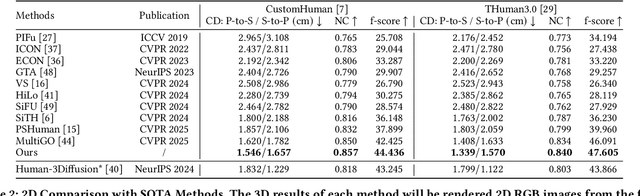
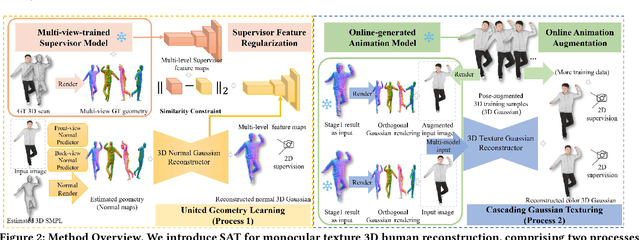
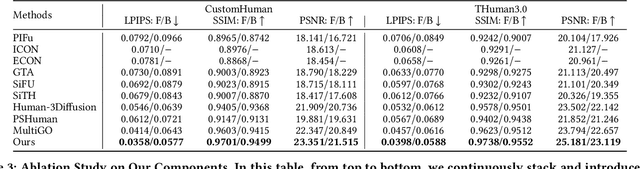
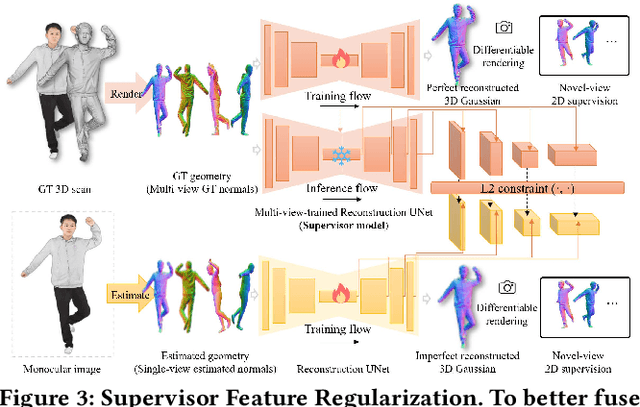
Monocular texture 3D human reconstruction aims to create a complete 3D digital avatar from just a single front-view human RGB image. However, the geometric ambiguity inherent in a single 2D image and the scarcity of 3D human training data are the main obstacles limiting progress in this field. To address these issues, current methods employ prior geometric estimation networks to derive various human geometric forms, such as the SMPL model and normal maps. However, they struggle to integrate these modalities effectively, leading to view inconsistencies, such as facial distortions. To this end, we propose a two-process 3D human reconstruction framework, SAT, which seamlessly learns various prior geometries in a unified manner and reconstructs high-quality textured 3D avatars as the final output. To further facilitate geometry learning, we introduce a Supervisor Feature Regularization module. By employing a multi-view network with the same structure to provide intermediate features as training supervision, these varied geometric priors can be better fused. To tackle data scarcity and further improve reconstruction quality, we also propose an Online Animation Augmentation module. By building a one-feed-forward animation network, we augment a massive number of samples from the original 3D human data online for model training. Extensive experiments on two benchmarks show the superiority of our approach compared to state-of-the-art methods.
SMPL Normal Map Is All You Need for Single-view Textured Human Reconstruction
Jun 15, 2025Single-view textured human reconstruction aims to reconstruct a clothed 3D digital human by inputting a monocular 2D image. Existing approaches include feed-forward methods, limited by scarce 3D human data, and diffusion-based methods, prone to erroneous 2D hallucinations. To address these issues, we propose a novel SMPL normal map Equipped 3D Human Reconstruction (SEHR) framework, integrating a pretrained large 3D reconstruction model with human geometry prior. SEHR performs single-view human reconstruction without using a preset diffusion model in one forward propagation. Concretely, SEHR consists of two key components: SMPL Normal Map Guidance (SNMG) and SMPL Normal Map Constraint (SNMC). SNMG incorporates SMPL normal maps into an auxiliary network to provide improved body shape guidance. SNMC enhances invisible body parts by constraining the model to predict an extra SMPL normal Gaussians. Extensive experiments on two benchmark datasets demonstrate that SEHR outperforms existing state-of-the-art methods.
Unify3D: An Augmented Holistic End-to-end Monocular 3D Human Reconstruction via Anatomy Shaping and Twins Negotiating
Apr 25, 2025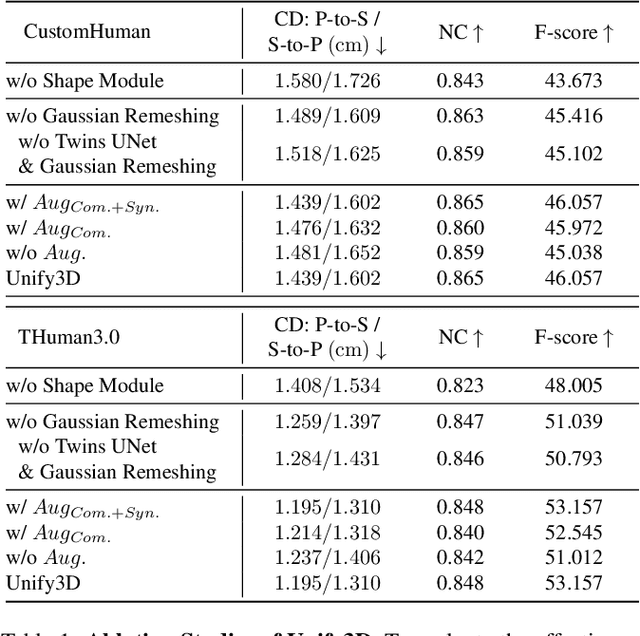
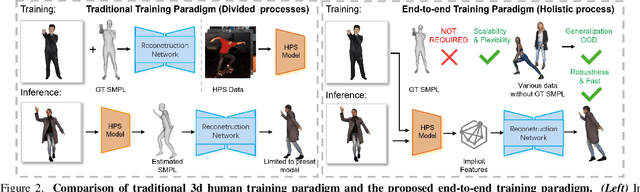
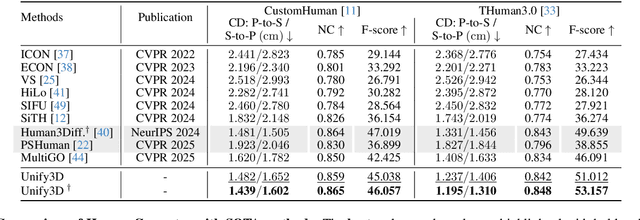
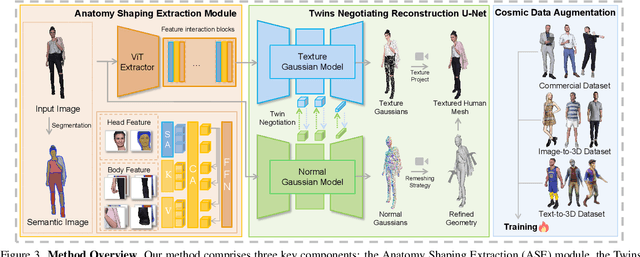
Monocular 3D clothed human reconstruction aims to create a complete 3D avatar from a single image. To tackle the human geometry lacking in one RGB image, current methods typically resort to a preceding model for an explicit geometric representation. For the reconstruction itself, focus is on modeling both it and the input image. This routine is constrained by the preceding model, and overlooks the integrity of the reconstruction task. To address this, this paper introduces a novel paradigm that treats human reconstruction as a holistic process, utilizing an end-to-end network for direct prediction from 2D image to 3D avatar, eliminating any explicit intermediate geometry display. Based on this, we further propose a novel reconstruction framework consisting of two core components: the Anatomy Shaping Extraction module, which captures implicit shape features taking into account the specialty of human anatomy, and the Twins Negotiating Reconstruction U-Net, which enhances reconstruction through feature interaction between two U-Nets of different modalities. Moreover, we propose a Comic Data Augmentation strategy and construct 15k+ 3D human scans to bolster model performance in more complex case input. Extensive experiments on two test sets and many in-the-wild cases show the superiority of our method over SOTA methods. Our demos can be found in : https://e2e3dgsrecon.github.io/e2e3dgsrecon/.
MultiGO: Towards Multi-level Geometry Learning for Monocular 3D Textured Human Reconstruction
Dec 04, 2024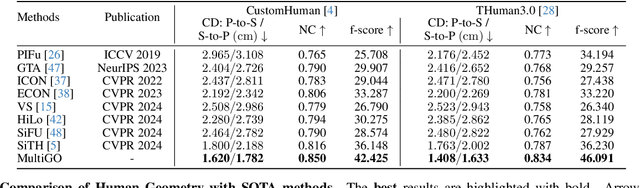
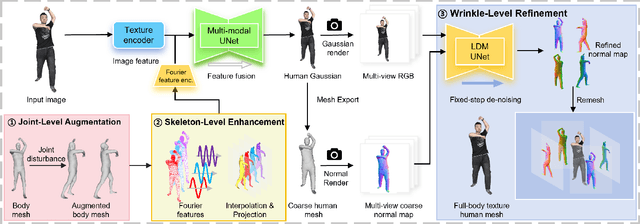
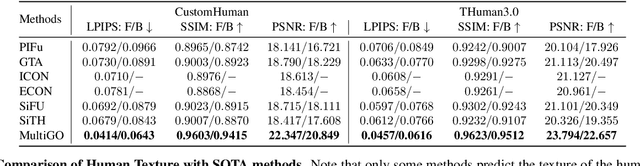
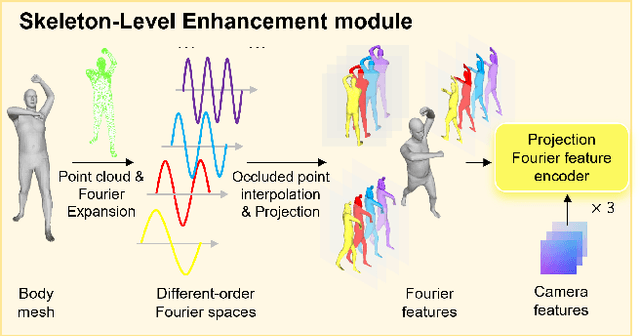
This paper investigates the research task of reconstructing the 3D clothed human body from a monocular image. Due to the inherent ambiguity of single-view input, existing approaches leverage pre-trained SMPL(-X) estimation models or generative models to provide auxiliary information for human reconstruction. However, these methods capture only the general human body geometry and overlook specific geometric details, leading to inaccurate skeleton reconstruction, incorrect joint positions, and unclear cloth wrinkles. In response to these issues, we propose a multi-level geometry learning framework. Technically, we design three key components: skeleton-level enhancement, joint-level augmentation, and wrinkle-level refinement modules. Specifically, we effectively integrate the projected 3D Fourier features into a Gaussian reconstruction model, introduce perturbations to improve joint depth estimation during training, and refine the human coarse wrinkles by resembling the de-noising process of diffusion model. Extensive quantitative and qualitative experiments on two out-of-distribution test sets show the superior performance of our approach compared to state-of-the-art (SOTA) methods.
NOVA-3D: Non-overlapped Views for 3D Anime Character Reconstruction
May 21, 2024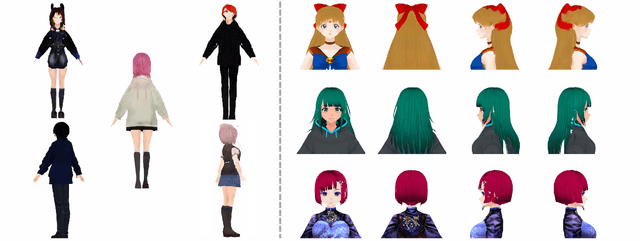

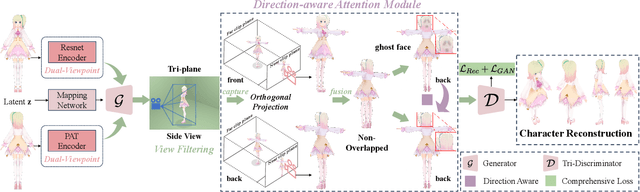
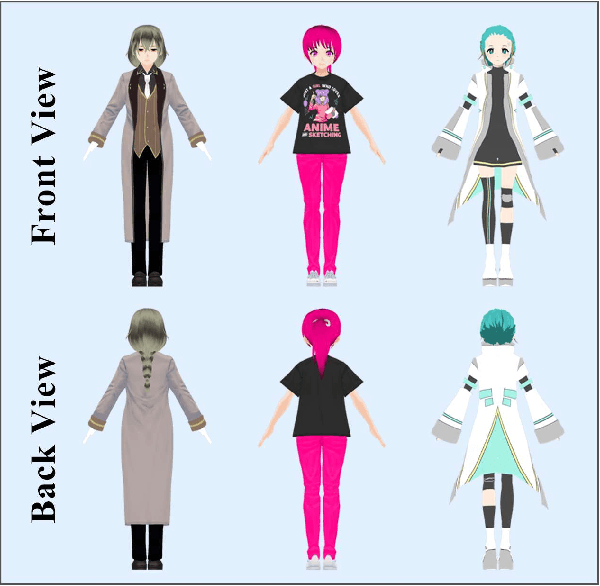
In the animation industry, 3D modelers typically rely on front and back non-overlapped concept designs to guide the 3D modeling of anime characters. However, there is currently a lack of automated approaches for generating anime characters directly from these 2D designs. In light of this, we explore a novel task of reconstructing anime characters from non-overlapped views. This presents two main challenges: existing multi-view approaches cannot be directly applied due to the absence of overlapping regions, and there is a scarcity of full-body anime character data and standard benchmarks. To bridge the gap, we present Non-Overlapped Views for 3D \textbf{A}nime Character Reconstruction (NOVA-3D), a new framework that implements a method for view-aware feature fusion to learn 3D-consistent features effectively and synthesizes full-body anime characters from non-overlapped front and back views directly. To facilitate this line of research, we collected the NOVA-Human dataset, which comprises multi-view images and accurate camera parameters for 3D anime characters. Extensive experiments demonstrate that the proposed method outperforms baseline approaches, achieving superior reconstruction of anime characters with exceptional detail fidelity. In addition, to further verify the effectiveness of our method, we applied it to the animation head reconstruction task and improved the state-of-the-art baseline to 94.453 in SSIM, 7.726 in LPIPS, and 19.575 in PSNR on average. Codes and datasets are available at https://wanghongsheng01.github.io/NOVA-3D/.